

The Founder Dependency Framework
You've built the business. You know how it works. You know the clients, the decisions, the processes and the problems but when everything depends on your knowledge and involvement, growth can become surprisingly difficult.
Because the bigger the business gets, the more expensive your involvement becomes. Not just financially.
In time.
In attention.
In decision-making capacity.
And eventually, in your ability to step away.
The Founder Dependency Framework helps you understand where that dependency exists and what it is doing to your business.
What is founder dependency?
Founder dependency is the extent to which a business relies on its founder's personal knowledge, decisions, involvement and availability to operate effectively.
Some founder involvement is healthy.
Your business should benefit from your leadership, experience and vision. The problem is when the business cannot function effectively without you. That's when founder dependency becomes an operational risk.
You might have a team. You might have systems. You might even have documented processes.
And yet:
The decisions still come back to you. The important knowledge still lives in your head. Your team still needs you to solve problems. Clients still depend on you personally. Taking time away still feels risky.
That's founder dependency.
The five domains of founder dependency
The Framework looks at five connected areas.
They don't operate in isolation.
A dependency in one area can create dependency somewhere else.
1. Desicions
Who gets to decide?
A business can have a capable team and still be completely dependent on its founder for decision-making.
If your team constantly asks:
“What should I do?”, “Can I do this?”, “Does Gemma want this?”
then the issue isn't necessarily capability. It may be authority.
Decision dependency happens when the founder remains the default decision-maker for too many things.
Reducing it means creating clearer decision boundaries so people know:
What they own.
What they can decide.
When they need to escalate.
2. Knowledge
How much of the business lives in your head?
Every founder carries knowledge that isn't written down. That's normal.
The problem comes when essential knowledge exists only with you.
How does that client like things done?
What happens when this particular problem occurs?
Why do we do things this way?
What happens if this process breaks?
If nobody else can answer those questions without you, the business has a knowledge dependency.
The solution isn't necessarily a giant library of SOPs.
It's making sure the right knowledge is accessible to the right people at the right time.
3. Delivery
How much of the work still requires you?
You can delegate tasks without actually reducing founder dependency.
A team member might complete 90% of the work, but if you still need to check it, approve it or step in when something changes, the dependency remains.
Delivery dependency looks at how much of your actual product or service relies on your personal involvement.
Reducing it means creating:
Clear ownership.
Reliable processes.
Appropriate quality controls.
And enough capability in your team for work to continue without constant founder intervention.
4. Revenue
How dependent is your income on you personally?
This is often the dependency founders notice first.
If you're the person who:
- brings in the clients
- maintains every relationship
- delivers the expertise
- closes every sale
- solves every problem
then stepping away can feel like stepping away from revenue.
Revenue dependency isn't necessarily something you can eliminate completely.
But you can understand where your personal involvement is creating a constraint on growth.
5. Resilience
What happens when you're unavailable?
This is where the other four domains come together.
Imagine you're suddenly unavailable for two weeks.
Can the business keep moving?
Can your team make decisions?
Can they access what they need?
Can delivery continue?
Can clients be supported?
Can revenue keep coming in?
Or does everything eventually find its way back to you?
Resilience isn't about building a business that never needs you.
It's about building one that can cope when you're not available.
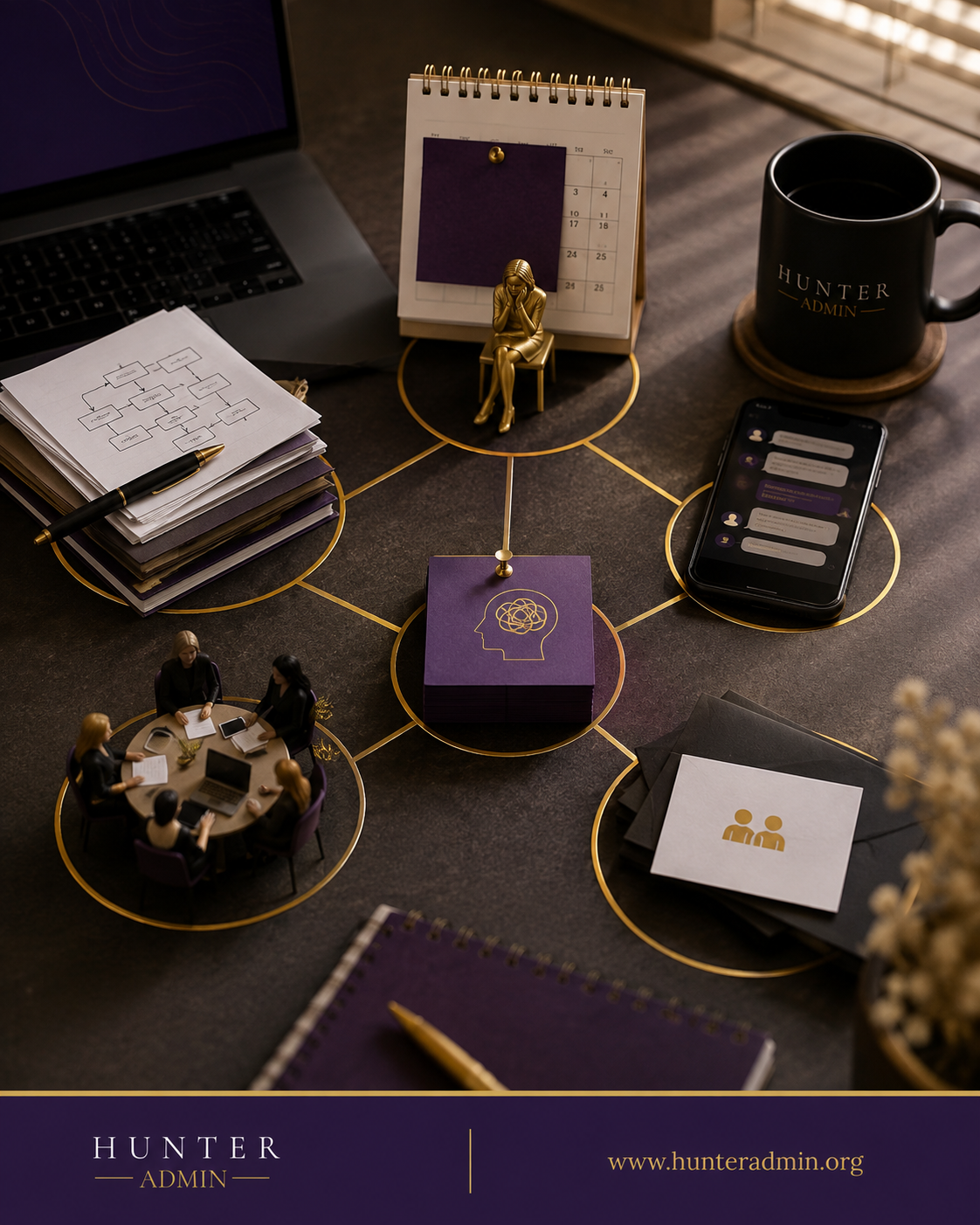
These five domains are connected..
Founder dependency rarely sits neatly inside one box.
For example:
Your team doesn't make decisions because they don't have the knowledge.
They don't have the knowledge because the process hasn't been documented.
The process hasn't been documented because you've always just done it yourself.
And you've kept doing it because you're worried about what happens if someone gets it wrong.
One dependency creates another.
That's why simply telling a founder to “delegate more” rarely solves the problem.
You need to understand the system underneath it.
The goal isn't to remove the founder.
It's to make their involvement intentional.
A healthy business can still need its founder.
It should need you for:
Vision. Leadership. Strategy. Relationships that genuinely require you. Decisions only you can make.
But it shouldn't need you to:
Approve every decision. Answer every question. Explain every process. Fix every problem. Check every piece of work. Keep everything moving.
There's a difference between being important and being indispensable to everything.
That's the difference we're interested in.
Where are you most needed?
The first step is understanding your current level of founder dependency.
The Founder Dependency Score gives you a quick assessment across all five domains.
Four minutes. Five domains. One clearer starting point.
Want to go deeper?
The Score tells you where your dependency sits. The Founder Dependency Diagnostic explores why.
Together, we can identify the operational patterns keeping you at the centre of the business and determine what needs to change first.
Building an owner-optional business doesn't happen overnight.
And it doesn't mean removing yourself from your business. It means gradually building the systems, ownership, knowledge and capability that allow you to choose where your involvement adds value.
That's the real goal.